


Bike Care & Setup
Your New Bike's First 100 km
What to check, what may settle, and when a small change deserves a mechanic's attention.

Before each early ride, check tyre pressure, wheel security, steering, brakes, shifting and contact points. Treat 100 km as a useful review point—not a countdown to a mandatory service. If something becomes loose, noisy or inconsistent, identify the cause before riding on.
Why can a new bike need adjustment?
A bicycle is a system of fasteners, bearings, cables, hoses, spokes, tyres and moving components. During the first rides, housings seat into their stops, brake surfaces bed in, contact points are fine-tuned and small assembly issues become easier to notice.
Safety is not something a bicycle grows into. Brakes, wheels and steering must work correctly from the first ride. The early kilometres simply reveal whether your fit has changed or a model-specific adjustment is needed.
If your bike was delivered partly assembled, complete the model-specific assembly and tuning steps before its first ride. The settling-in checks in this guide do not replace correct initial assembly.
Fastener specifications vary by frame, stem, handlebar, crank, brake and accessory. Use the marking on the component and the exact manufacturer manual. If the value is missing or you are unsure, ask the place of purchase or a qualified mechanic.
The two-minute check before every early ride
For the first several rides, take two minutes before leaving. You are looking for change: something that feels softer, looser, noisier or less consistent than it did previously.
Inflate within the range printed on the tyre and appropriate for your load and terrain. Look for cuts, bulges or a tyre bead that is not seated evenly.
Confirm each wheel is correctly seated and secured using the system fitted to your bike. Spin both wheels and look for a major wobble or unexpected contact.
Apply each brake separately while stationary. The lever must not pull to the grip, feel suddenly soft or lose braking force.
Make sure the handlebar is aligned with the front wheel. Hold the front brake and gently rock the bike; a knock around the headset needs investigation.
Nothing should rotate or move under normal hand pressure. Check that pedals were installed on the correct sides and are fully engaged.
A light tick may have a simple cause, but a new sound is information. Find its source before turning a small issue into damage.
What to watch during the first 20–50 km
Brake feel and bedding-in
New brake pads and rotors need controlled use to develop consistent braking. Follow the brake manufacturer’s bedding procedure where one is supplied. Do not contaminate a disc rotor or pad with chain lubricant, grease or cleaning products not intended for brakes.
Minor disc-brake noise can have several causes. Reduced stopping power is different: if a lever suddenly pulls close to the grip, fluid appears around the brake, or braking becomes inconsistent, stop and have it checked.
Shifting after the first rides
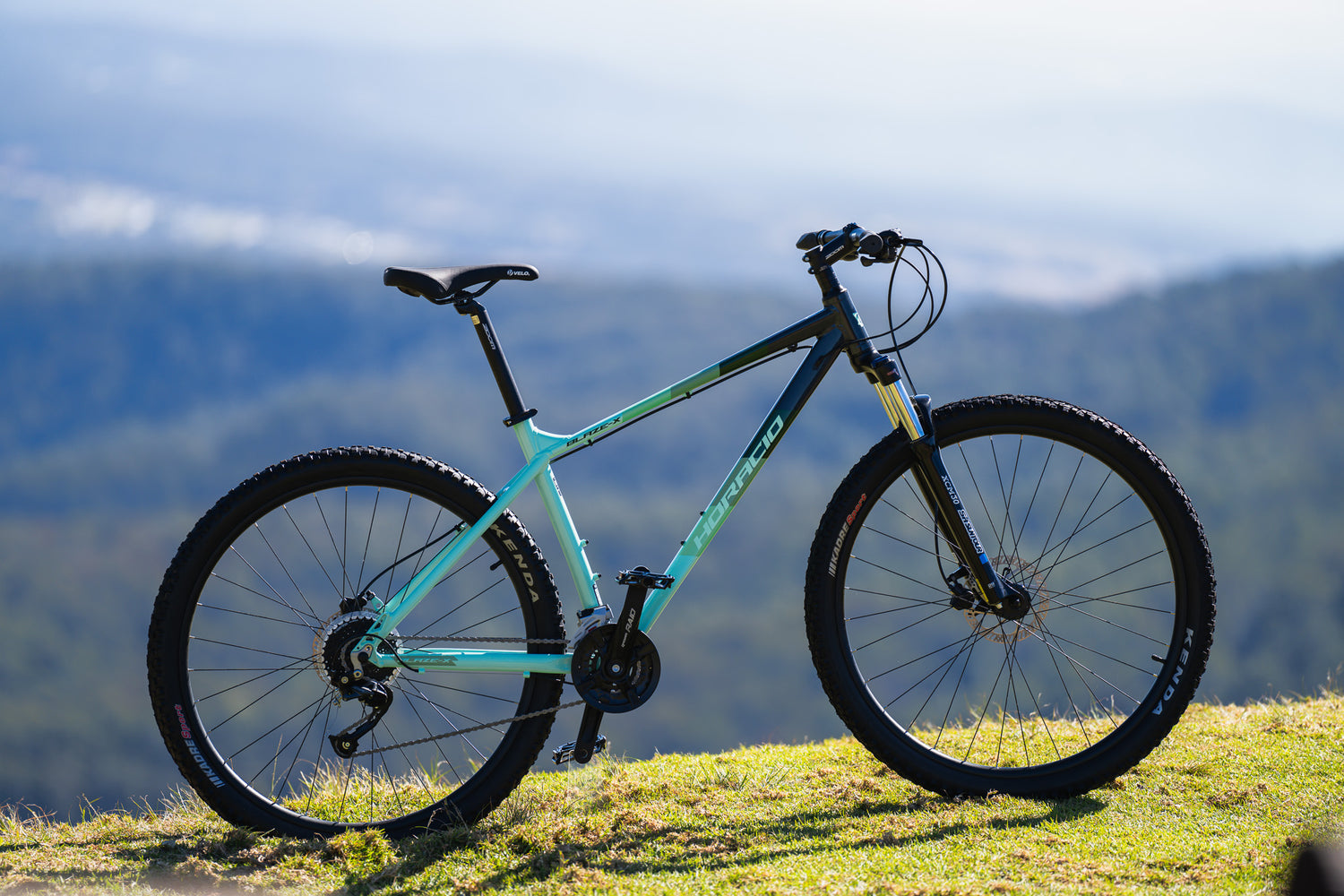
Many Horacio mountain bikes—including the Blaze CUES and ThunderX—use a cable-operated derailleur. Cable housing can settle into its stops, causing a slow shift, hesitation in one direction or chain noise in selected gears. This is normally corrected with proper indexing, not by moving limit screws at random.
Serenio is different. Its gearing sits inside the automatic rear-hub system, so conventional derailleur adjustments do not apply. Follow the instructions for the exact hub system.
Fit is part of the first service
Notice pressure on your hands, knees, neck and sit bones. A small saddle-height or control-angle correction can make a large difference, but pain is not a required “break-in” stage. Make one measured change at a time so you know what helped.
If your bike has a Gates belt drive
If you ride our Serenio, this is the part to remember: its Gates CDN belt is not maintained like a chain. Do not apply chain oil, chain wax or another lubricant. After a wet or gritty Brisbane ride, Gates specifies clean water for removing debris; use a soft brush when needed.
Look at belt condition, tension and sprocket alignment instead. A belt that skips, tracks towards one side, becomes unusually noisy or shows damage should be inspected rather than tightened by guesswork. Keep the belt in its natural shape—avoid sharp bends, twisting or forcing it over a sprocket.
If your bike has a removable lithium-ion battery
A removable battery may be taken off the bike for charging or storage by following the bike’s instructions. Before riding, confirm it is correctly seated and locked. Use the supplied or specifically approved charger and charge in a suitable dry location.
A lithium-ion e-bike battery does not need intentional deep-discharge “activation” or several full discharge cycles as a break-in procedure. It can be recharged from a partial state of charge. Avoid deliberately running it to zero, and do not leave it stored for a long period while fully depleted. The exact charging and storage instructions supplied with the Horacio battery take priority.

What to review around 100 km
One hundred kilometres is a useful checkpoint, not an expiry date. A bike used daily on Brisbane hills, gravel or wet roads may need attention sooner than one ridden gently on clean shared paths.
| Area | What to review | Appropriate next step |
|---|---|---|
| Brakes | Lever feel, pad contact, disc-rotor condition and stopping consistency | Clean only with suitable products; book adjustment if braking is weak or inconsistent |
| Gears | Accurate shifting across the intended gear range, without skipping under load | Index the system correctly or have it adjusted; avoid guessing at limit screws |
| Wheels | Correct seating, secure retention, lateral movement, damaged spokes or an obvious wobble | Stop and seek inspection if the wheel is loose, damaged or significantly out of true |
| Headset and controls | No knocking at the headset; handlebar, levers and saddle remain aligned | Use the exact adjustment procedure and component torque specification |
| Drivetrain | Chain or belt condition, unusual noise and correct operation for the fitted system | Maintain a chain as specified for that chain. For a Gates belt, use water rather than oil or wax, and have tension and alignment checked when symptoms appear |
| E-bike system | Battery mounting, cables, display warnings and assistance operating normally | A removable battery may be taken off the bike as described in its instructions. Do not disassemble the motor or battery casing; contact authorised support for electrical faults |
What common early symptoms can mean
A light brake rub: first confirm the wheel is seated correctly. Persistent rubbing may need caliper alignment or rotor inspection.
Slow or noisy shifts: cable settling or derailleur indexing may be involved. Skipping under pedal load deserves prompt attention because it can affect control and damage parts.
A knock when braking: it may come from headset play or another loose interface. Do not keep riding until the source is identified.
A repeating click while pedalling: note whether it follows every pedal revolution or wheel revolution. This helps a mechanic narrow the cause before any adjustment is made.
A saddle that drops or twists: stop and correct it using the requirements for the fitted frame, seatpost and clamp. Excessive tightening can damage these parts.
Tell us whether a sound happens while pedalling, braking, coasting or turning, and whether it follows each pedal or wheel revolution. A photo or short video is usually more useful than adjusting something before the cause is known.
Stop riding and arrange an inspection if:
- a wheel is loose, incorrectly seated or visibly damaged;
- the handlebar or stem moves independently of the front wheel;
- either brake loses power, leaks fluid or the lever pulls unusually far;
- the crank or pedal is loose, or the drivetrain skips heavily under load;
- you find a crack, deep impact mark, damaged electrical cable or battery fault;
- the bicycle’s handling changes suddenly or you cannot identify a new structural noise.
What should you adjust yourself?
Routine tyre inflation, basic cleaning and observations are suitable for most owners. More advanced work depends on your tools and experience. Brake installation, wheel retention, headset and stem adjustment, crank systems and e-bike electrical components are safety-critical or model-specific.
If you bought a Horacio bike and are unsure what applies to your model, use the assembly and tuning guidance, contact technical support, or arrange an inspection through the Horacio workshop.
Quick questions
First 100 km FAQ
Does every new bike need a service at exactly 100 km?
No. One hundred kilometres is a practical review point, not a universal service interval. Follow the schedule for your exact bike and components, and act earlier if braking, steering, wheel security or shifting changes.
Is some brake noise normal on a new bike?
Occasional noise can occur while brake surfaces bed in or when conditions are wet, but noise combined with weak, inconsistent or contaminated braking needs attention. Use the brake manufacturer’s instructions.
Why did the gears change after a few rides?
Cable housing can settle into its stops on a derailleur system, which may slightly affect indexing. A small correct adjustment can restore shifting. Internal and automatic hub systems use different procedures.
Does a Gates belt need oil or chain wax?
No. Gates specifies water to remove debris and says the belt and sprockets do not require lubrication. Check belt condition, tension and alignment instead.
Should I fully discharge a new e-bike battery before charging it?
No intentional deep-discharge conditioning is required for a lithium-ion e-bike battery. Use the approved charger, recharge normally and follow the battery instructions supplied with the bike.
Can I service an e-bike motor or battery at home?
You may remove a removable battery from the bike by following its operating instructions, and basic external checks and cleaning may be appropriate. Do not disassemble the battery casing or motor. Electrical faults should be handled through authorised technical support.
Sources and review notes
- Shimano: regular inspections before riding the bicycle
- Park Tool: complete bike assembly checklist
- Park Tool: pre-ride inspection and on-the-ride diagnosis
- Tektro: official hydraulic disc brake manuals
- Gates Carbon Drive: technical manual and belt-care guidance
- Bafang battery manual: charging, storage and deep-discharge guidance
Editorial note: This guide is general information. The instructions and specifications supplied with the exact bicycle and components take priority. External technical references are listed for transparency and do not imply endorsement of Horacio Bikes. Last technical review: 2 September 2026.